
From the desk of Jerrod Ferguson, CFP®- Broadening market leadership, the AI question, and why diversification still matters

Dear Clients and Friends,
As summer comes to a close, we’ve enjoyed hearing about the experiences that made it memorable for so many of our clients, from exciting trips and family getaways to dropping kids off at college and beginning new chapters.
My family is in a new season as well, with Jocelyn starting second grade and Jones beginning Pre-K. It’s a great reminder of how quickly life moves and why being intentional about what matters most is so important.
As we head into the final stretch of the year, our focus remains the same: helping you cut through the noise, understand what matters, and make confident decisions that keep you moving toward the life you’ve worked hard to create.
Climbing the Wall of Worry
If you looked at where the market started the year and where we are today, you might think 2026 has been relatively uneventful. That could not be further from the truth.
After reaching record highs early in the year, the S&P 500 declined nearly 10% through late March as investor concerns intensified. From its March 30 low, the market then rallied more than 20%, returning to new all-time highs by mid-August. As of August 20, the S&P 500 is up 12.45% year to date.¹
Once again, the journey has been anything but a straight line and investors certainly have not run out of reasons to worry.
The labor market has shown signs of softening. Inflation has remained stickier than many expected. Higher oil prices and geopolitical uncertainty have created additional concerns. Higher interest rates have also brought renewed attention to At the same time, stock market valuations remain elevated by historical standards, leaving many investors wondering whether the market has simply become too expensive.
We understand these concerns, and they deserve our attention. But they also deserve perspective.
From an investor psychology standpoint, the presence of so much skepticism may actually be healthier than it first appears. Markets are often most vulnerable when optimism becomes nearly universal, risks are easily dismissed, and asset prices are priced for perfection. Those periods of euphoria can ultimately become periods of maximum financial risk.
That does not seem to describe today’s environment.
Despite markets trading near record highs, there remains considerable uncertainty around the economy, interest rates, government policy, geopolitics, inflation and the sustainability of the market’s (continued) advance. In other words, there remains a meaningful “wall of worry” for this market to climb.
The path so far this year offers another reminder that periods of uncertainty and market volatility are a normal part of long-term investing, and that staying disciplined through those periods can be just as important as identifying what comes next.
Markets at a Glance
| Market | Benchmark | YTD Return |
| U.S. Large Companies | S&P 500 Index | +12.45% |
| International Stocks | MSCI ACWI ex USA Index | +16.94% |
| U.S. Bond Market | Bloomberg U.S. Aggregate Bond Index | -0.17% |
| Year to Date Through August 20, 2026¹ |
|
U.S. stocks have had another strong year, but they are not the only place investors are being rewarded. International stocks have outperformed the S&P 500 so far this year, while one of the more interesting developments within the U.S. market has been a meaningful change in which companies are actually leading it.
Index returns are unmanaged and do not reflect the deduction of any fees or expenses. Index returns reflect all items of income, gain and loss and the reinvestment of dividends and other income. You cannot invest directly in an Index
Market Leadership Is Broadening
If you have been reading these updates over the past few years, this should not be a new message.
We have written repeatedly about the importance of diversification, even while a small group of the largest U.S. technology companies dominated market returns. At times, that discipline may have felt frustrating.
In our 2024 Q3 update, I even wrote, “Trees don’t grow to the sky; the market will eventually remind us of this.” At the time, the Magnificent Seven were still dominating market returns.
2026 is providing a good reminder of why we remained committed to that discipline.
In 2023, the Magnificent Seven gained approximately 112%, compared with 24% for the other 493 companies in the S&P 500. That gap has steadily narrowed. Through June 30 of this year, the Magnificent Seven as a group were actually down approximately 2%, while the other 493 companies had gained roughly 16%.²
All seven “Magnificent Seven” companies outperformed the S&P 500 in 2023. Six did in 2024, only two in 2025, and through June 30 of this year, only one had outperformed the broader index.
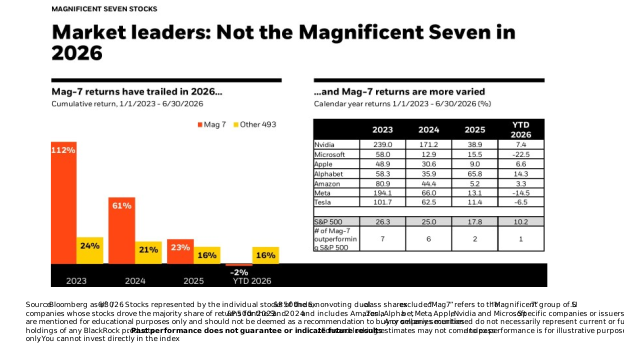
Source: Bloomberg as of June 30, 2026.²
Past performance shown is not indicative of future results, which could differ substantially
Performance returns for periods of less than one year are not annualized
Does this mean these are suddenly bad companies? Absolutely not. Many are high-quality businesses.
It simply means market leadership does not last forever.
Taking Profits on the Way Up
When an individual stock has appreciated significantly, selling it can be surprisingly difficult. Investors naturally become attached to companies that have rewarded them, and the longer a stock continues to rise, the easier it becomes to believe it will keep doing so.
Again, trees do not grow to the sky.
For clients with concentrated individual-stock positions, we prefer to develop a proactive plan before emotion gets involved. Depending on the company, we may establish predetermined price targets using factors such as valuation, forward-looking expectations, balance-sheet strength and outside analyst research.
If those agreed-upon targets are reached, shares can be systematically trimmed.
Are we going to perfectly identify the top? Of course not. That is not the goal. The goal is to take some emotion out of the decision, reduce company-specific risk over time, and take profits on the way up.
Diversification Is About Preparing, Not Predicting
This year’s changing market leadership reinforces one of our core investment beliefs: Diversification matters precisely because we do not know what will lead next.
Diversification does not simply mean owning more stocks. It means maintaining exposure across large, mid-sized and smaller companies, growth and value styles, U.S. and international markets, and different asset classes based on the needs of your financial plan.
This can be difficult when one area of the market seems impossible to beat. We’ve lived through that over the past several years. Now look at 2026.
International stocks are up 16.94%, compared with 12.45% for the S&P 500,¹ while the other 493 companies in the S&P 500 significantly outperformed the Magnificent Seven through the first half of the year.²
That is exactly the point.
Diversification is not designed to make sure we own only the best-performing investment every year. If we could predict that consistently, we would not need diversification. It is about preparing for a future we cannot perfectly predict and reducing our dependence on any one company, investment style, country or market having to be right.
And that may become even more important as we consider one of the largest investment stories in the world today.
Artificial Intelligence: Bubble, Boom, or Something Bigger?
Few topics have generated more excitement, investment and skepticism than artificial intelligence (AI).
With technology stocks producing extraordinary returns and companies committing enormous amounts of money to AI infrastructure, we understand why comparisons are being made to the dot-com bubble of the late 1990s.
But there are some important differences.
From 1993 through 1999, technology stocks gained nearly 1,100%, including seven consecutive years of returns of approximately 20% or better. By comparison, technology stocks gained approximately 569% from 2019 through June 30, 2026, and that period included the bear market of 2022.³
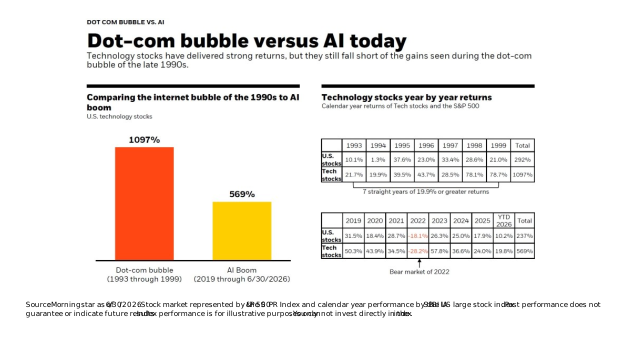
Source: Morningstar as of June 30, 2026.³
Past performance shown is not indicative of future results, which could differ substantially
Performance returns for periods of less than one year are not annualized
Perhaps more importantly, many of today’s leading technology companies are established, highly profitable businesses generating significant earnings and cash flow. That is meaningfully different from portions of the late-1990s technology boom, when enormous valuations were sometimes assigned to companies with little revenue and, in many cases, no profits.
That doesn’t mean there aren’t areas where enthusiasm and investment may have gotten ahead of themselves. One of the biggest questions is whether the extraordinary amounts of money being invested in chips, data centers, models and AI infrastructure will ultimately generate an adequate return.
We don’t know yet.
But what makes this particularly interesting is how early we may still be.
AI Adoption Is Still Early
At the end of 2025, only about 17% of businesses reported using AI in at least one business function.⁴ Adoption is higher in areas like information, professional services, finance and insurance, but across much of the broader economy, implementation remains relatively limited.
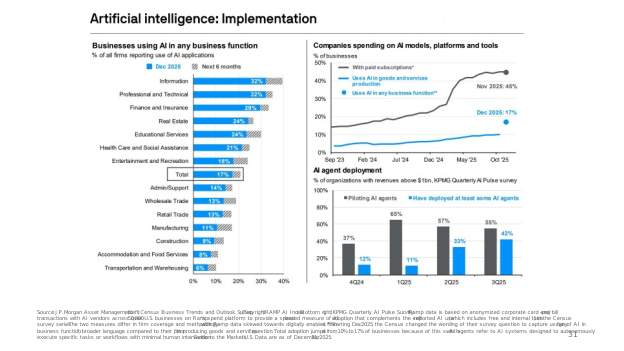
Source: J.P. Morgan Asset Management, Guide to the Markets, U.S.⁴
Past performance shown is not indicative of future results, which could differ substantially
Performance returns for periods of less than one year are not annualized
We are seeing a small example of the potential right here at Vance Wealth. AI is already helping us complete certain tasks more efficiently, synthesize information faster and increase the amount of work our team can accomplish.
Of course, that raises an understandable concern: What does AI mean for jobs?
If businesses can accomplish the same amount of work with fewer resources, some jobs will change and certain roles may disappear.
But how many new jobs will AI create?
Think back to the emergence of the internet. There was tremendous concern about what it would do to existing jobs and industries. And yes, some jobs disappeared. But entire industries, businesses and professions were also created that would have been almost impossible to imagine beforehand.
AI may ultimately create a similar transformational shift. It may eliminate certain tasks and change some jobs, but it could also increase what each worker is capable of producing and create entirely new opportunities that are difficult for us to comprehend today.
Who Will Really Benefit From AI?
This brings us right back to diversification.
The first phase of the AI boom has understandably rewarded many of the companies building it. Semiconductors, data centers, cloud computing and AI models require enormous amounts of capital, and the companies providing that infrastructure have been some of the most obvious beneficiaries.
But will they capture all of the economic value AI creates? We don’t think so.
Over time, some of the biggest beneficiaries may be the companies that figure out how to use AI effectively, rather than simply the companies spending the most money building it today.
A manufacturer may use AI to reduce waste and improve production. A healthcare company may analyze information faster. A financial services company may automate administrative work and allow employees to spend more time serving clients. Smaller companies may gain access to capabilities that previously required much larger teams and technology budgets.
If businesses can use AI to produce more with the same resources, lower costs and improve margins, the economic benefits could spread far beyond today’s largest technology companies.
And we believe that strengthens the argument for diversification.
We do not know which companies will become the greatest beneficiaries of AI over the next five, ten or twenty years. Some may be today’s market leaders. Others may be companies or industries that are not obvious yet.
Our goal is not to predict which handful of companies will win the AI revolution. We want to participate in long-term innovation while maintaining the diversification and discipline needed for a future none of us can perfectly predict.
Preparing for What Comes Next
If there is one message we hope you take away from this update, it is this:
Successful investing does not require us to predict the next headline. It requires us to prepare for a range of outcomes.
We cannot know exactly where interest rates will be a year from now, which companies will emerge as the biggest beneficiaries of AI, or when the next period of market volatility will arrive.
What we can do is build a financial plan and portfolio designed to adapt as circumstances change.
That is the work we are doing for our clients every day.
As your financial quarterback, our role is to remain proactive, looking around the corner for potential risks and opportunities before they require a reaction. That means managing concentrated positions before they become outsized risks, maintaining diversification even when one area of the market feels impossible to beat, and continually making sure your investments remain aligned with the life you are ultimately asking them to support.
We often refer to this as building an all-weather portfolio.
The objective is not to build a portfolio that performs best in every market environment. No portfolio can do that. Instead, we want to balance the stability needed for shorter-term goals with the growth needed to preserve and increase purchasing power over decades.
Markets will continue to give us reasons for both optimism and concern. Our job is to understand both, filter out the noise, and provide clear, informed guidance so you can make confident decisions without allowing short-term headlines or emotions to derail a long-term plan.
For our clients, please know that we are doing this work on your behalf. We are continually evaluating your financial plan, portfolio, and the changing environment to identify where adjustments may add value. If something has changed in your life or you would simply like to revisit any part of your strategy, please reach out to your advisory team.
If you are not currently a Vance Wealth client and would value a second opinion, we offer a complimentary initial consultation. This is an opportunity to discover what is most important to you, identify potential gaps or opportunities, and determine whether there are areas where Vance Wealth may be able to add value.
We cannot predict what comes next. But we can plan for it.
Regards,
Jerrod Ferguson, CFP®
Partner, Wealth Advisor
Sources
- YCharts. S&P 500 Index, MSCI ACWI ex USA Index, and Bloomberg U.S. Aggregate Bond Index year-to-date performance. Data as of August 20, 2026.
- Bloomberg. Market Leaders: Not the Magnificent Seven in 2026. Data as of June 30, 2026. Stocks represented by the individual stocks of the S&P 500 Index; non-voting dual-class shares excluded. “Mag 7” includes Amazon, Tesla, Alphabet, Meta, Apple, Nvidia, and Microsoft.
- Morningstar. Dot-com Bubble versus AI Today. Data as of June 30, 2026. Stock market represented by the S&P 500 PR Index and calendar-year performance by the IA SBBI US Large Stock Index.
- J.P. Morgan Asset Management. Guide to the Markets: U.S. Artificial Intelligence: Implementation. Data as of December 31, 2025. Underlying sources include U.S. Census Bureau Business Trends and Outlook Survey, Ramp AI Index, and KPMG Quarterly AI Pulse Survey.
Disclosures:
The views expressed in this commentary are subject to change based on market and other conditions. These documents may contain certain statements that may be deemed forward‐looking statements. Please note that any such statements are not guarantees of any future performance and actual results or developments may differ materially from those projected. Any projections, market outlooks, or estimates are based upon certain assumptions and should not be construed as indicative of actual events that will occur. Past performance does not guarantee future results. The information provided is for educational and illustrative purposes only and does not constitute investment advice and it should not be relied on as such. It should not be considered a solicitation to buy or an offer to sell a security. It does not take into account any investor’s particular investment objectives, strategies, tax status or investment horizon. You should consult your attorney or tax advisor. All information has been obtained from sources believed to be reliable, but its accuracy is not guaranteed. There is no representation or warranty as to the current accuracy, reliability, or completeness of, nor liability for, decisions based on such information and it should not be relied on as such. Vance Wealth, LLC (“Vance Wealth”) is a registered investment advisor. Advisory services are only offered to clients or prospective clients where Vance Wealth and its representatives are properly licensed or exempt from licensure. The S&P 500 is an unmanaged index of 500 widely held stocks. Investors cannot invest directly in an index.